
Every bale is born with its own QR
The sorting plant packs uniform bales and small bales and tags each one with a QR carrying product and weight. From then on the bale has an identity: in the warehouse, in transit, on the stall.
ReWeR · reuse supply chain
A second life on foreign markets.
Why ReWeR
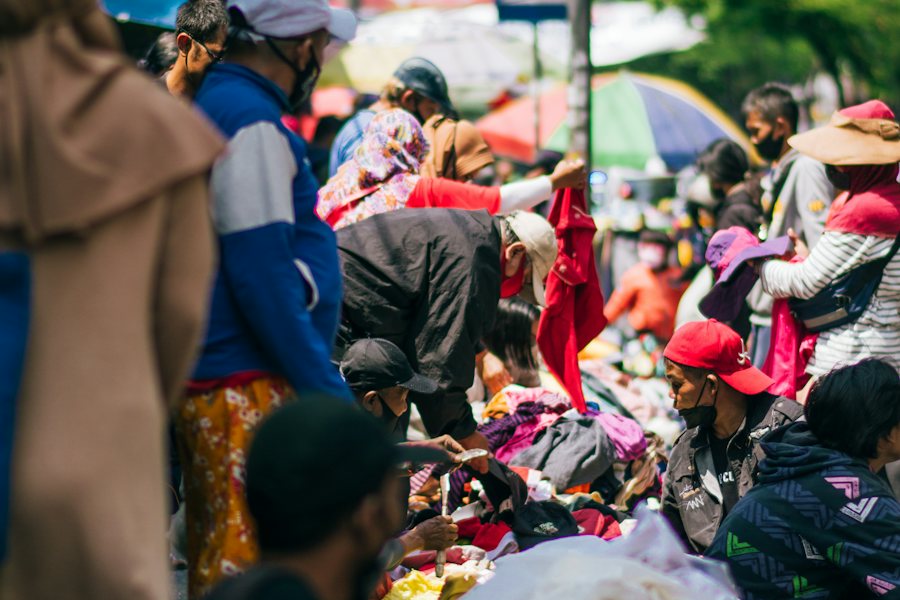
Sorted second-hand clothes leave in bales for Africa and other non-EU markets. Usually, once the container is closed, nobody can tell what is inside or how it arrives. ReWeR follows every bale to the trader’s stall and brings back what matters: the quality seen in the field.
A bale’s journey
Seven steps. The background follows a bale as you scroll.
The sorting plant packs uniform bales and small bales and tags each one with a QR carrying product and weight. From then on the bale has an identity: in the warehouse, in transit, on the stall.

Every bale is scanned as it enters the container, identified by its BIC code. Load quantity and weight add up automatically. It works with trucks too, handled as virtual containers.
Seal number and photo: without them, the shipment doesn’t leave. It is the proof that what was loaded is what will arrive.
Port of departure and destination, carrier, freight forwarder, number plates, departure date and estimated days in transit: all in one record, available to whoever needs it.
On arrival, the importer or wholesaler photographs the intact seal and takes receipt of the container. Every change of ownership stays on record, bale by bale.
Traders sign up from their phone, scan the QR of the bale they want and send a request. The distributor confirms: the bale changes hands, paper-free.
Whoever opens the bale rates it: as described, below spec but acceptable, or below spec and rejected, with notes and photos when needed. The verdict travels back up the supply chain to whoever sorted it.
The players


Sorts, packs, ships.
Take the load to its destination.
Importer or wholesaler: receives, checks, distributes.
They sell at retail. And they rate.
Oversees the whole supply chain.
Quality from the field
Not a spot check in the warehouse: quality is rated by the people who handle the goods every day, in the destination market. And the verdict goes back to whoever did the sorting.
The bale matches what was declared: product, weight, quality.
Confirms the sorting works.
There are differences, but the goods can still be sold.
A signal to adjust the sorting.
The goods don’t match and can’t be sold.
Documented with photos, it reaches the origin straight away.
Gamification
Retail traders aren’t the last link: they are the most valuable source of information on the goods. ReWeR brings them in with simple tools, designed for the phone.
New game mechanics to reward those who take part most and make field information even richer.
Illustrative example · demo data
The network dashboard
The supervisor sees operators, volumes, shipments under way and average quality: where the supply chain works and where to step in.
Demo data · illustrative example
Why it matters
A second life for every garment
A resold garment doesn’t need disposing of, or making from scratch.
Proof at every step
QR codes, photographed seals and changes of ownership: the reuse supply chain has its proof.
The market teaches the sorters
Market verdicts go back to the sorters: fewer disputed bales, goods better suited to each market.
Market traders, active players
Market traders join the supply chain as active players, with simple tools and their own community.
Contact